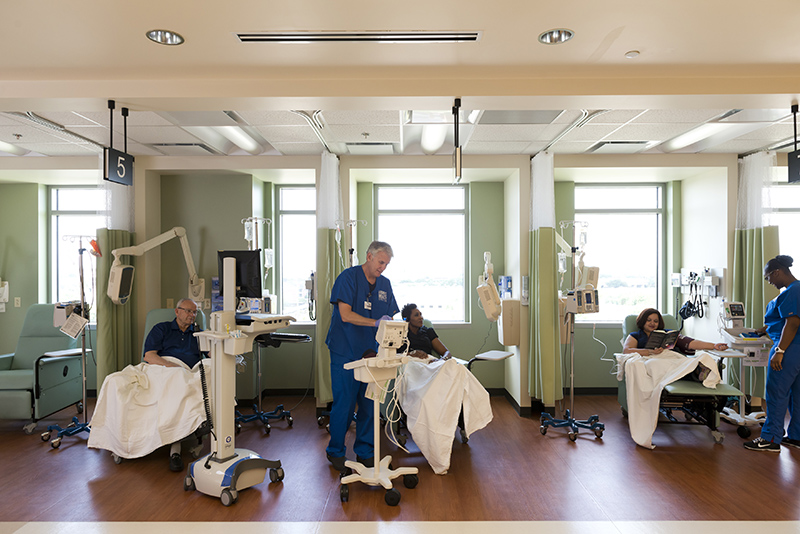
 Harris Health has created a dedicated oncology service line that helps cancer patients connect with all the diagnostic, treatment and support services needed to sustain their healthcare journey.
Harris Health's approach to cancer care is both comprehensive and highly coordinated, bringing together a multidisciplinary team that may include medical oncologists, surgeons, radiation oncologists, nurses, genetics counselors, pathologists, nutritionists, interventional radiologists and a host of other experts — all focused on a single patient's needs.
This collaborative model ensures that every aspect of a patient’s diagnosis, treatment and support is thoughtfully integrated with all providers working in alignment to deliver patient-centered care. That team-based model is anchored by a “meet patients where they are” philosophy.
“However, a patient enters the system, the goal is seamless access to care” says Amineh Kostov, senior vice president, System Service Lines, Harris Health. “Even for someone who's well versed in healthcare and very experienced with the healthcare system, a cancer diagnosis is still overwhelming and difficult to navigate. We have to be very intentional about how we organize ourselves as a system — the access points, the resources we provide — to ensure that experience is beneficial to them, because they're going through one of the most challenging times in their lives.”
Whether it’s detecting a suspicious lump in a breast at a community health fair, finding elevated t-cells in bloodwork during an annual physical exam or seeing an unidentified lung mass during a maternal wellness ultrasound exam, Harris Health’s oncology services are available for all patients.
But technology and expertise are only part of the picture. What distinguishes Harris Health's oncology program is seeing each patient as an individual. “Nothing is cookie-cutter here,” says Diana Mathai, director, Radiology and Radiation Oncology, Harris Health Smith Clinic.
For cancer care, where every presentation of the disease is unique, that distinction matters enormously. “The vast majority of the patients we see in our department are stage three and four,” Mathai explains. “While that may be considered palliative care at other organizations, we treat them as curative cases.”
For a population that relies on this safety-net healthcare provider, Harris Health’s services are lifesaving. With even more exciting developments on the horizon, Harris Health's oncology services are only getting stronger.
Cancer is such a personal experience and any individualized care plan for each patient extends beyond the exam room, radiation treatment or the infusion center.
“We try to meet patients where they are in their cancer journey,” says Amineh Kostov, senior vice president, System Service Lines, Harris Health. “Cancer care isn’t one size fits all. Patients come to us at different diagnosis and treatment stages, and our role is to guide them through the process, connect them with the right specialists and ensure they have the support they need.”
In radiation oncology, personalization is crucial. Each patient receives a one-hour consultation where the radiation oncologist meets with the patient, explains their diagnosis, and what might be the best course of action. It’s an educational moment where patients can have all their questions answered before giving their informed consent to what could be a potential marathon of treatments lasting anywhere from one to six weeks.
“Furthermore, Harris Health’s care is always at the cutting-edge of what’s available,” says Diana Mathai, director, Radiology and Radiation Oncology, Harris Health Smith Clinic. “Our doctors are looking at the latest academic research and literature and bringing those advances into the clinical environment — implementing successful trials and developing further research.”
Taken together – the breadth of services, the multiple accolades and recognitions, and the high level of diagnostic, treatment and support care offered – Harris Health’s oncology services are regarded as some of the best in Texas. They’re anchored by the health system’s accomplished, mission-driven staff.
“It takes real heart to work here,” Mathai agrees. “You come here because you truly live and breathe the mission of this organization.”
Patients who complete treatment move on to a dedicated survivorship clinic, where they receive ongoing care plans, imaging and physical assessments to monitor for recurrence.
“The quality here is just top notch,” Mathai says. “God forbid that me or a loved one ever had to have care for oncologic reasons, I would not hesitate to reach out to any one of the Harris Health providers and say take care of us.”
Cancer care extends far beyond medical treatment. While Harris Health’s cancer care is nationally recognized, patients also receive excellent support and assistance programs.
In the center of it all is its Cancer Resource Centers. Through these centers located at its facilities — Lyndon B. Johnson Hospital and Smith Clinic — newly diagnosed patients attend orientation sessions that introduce available services and connections to care management, emotional support and navigation resources.
“When patients first receive a cancer diagnosis, they’re often overwhelmed and trying to process a lot of information,” says Krystal Luong, supervisor, Cancer Resource Center, Harris Health. “The orientation helps patients understand what to expect so they feel more supported and confident about the next steps in their care.”
Patients often face challenges related to transportation, food insecurity, finances, emotional health and daily life responsibilities. Harris Health addresses those needs through its extensive support services.
Resources include:
● Community health workers who help patients navigate care
● Transportation assistance for appointments
● Survivorship programs
● Art therapy support groups
● Peer mentoring through cancer survivor volunteers
● Wigs, head coverings and breast prostheses
● Connections to food assistance and community resources
“Our staff walk around and talk to patients as they are sitting in their chemo chair — and we celebrate with them when they ring the bell on their last chemo (treatment),” Luong says.
Affectionately called the “wig shop,” the resource center provides head covers, wigs and hats, “anything we can do to help boost their self-esteem so they can go through their daily lives,” Luong adds. “The goal is to remove barriers that might prevent someone from continuing treatment and to support the whole person—not just the disease.”
In addition to diagnostic, treatment and support services, Harris Health’s cancer care is guided by research-based protocols and nationally recognized clinical trials.
That intentionality of research-driven care is reflected across a wide range of services including laboratory and diagnostic imaging, radiation therapy and chemotherapy, surgery and genetic counseling – demonstrating the extensive reach of specialty integration at Harris Health. Through partnerships with Baylor College of Medicine, McGovern Medical School at UTHealth Houston and University of Texas MD Anderson Cancer Center, patients are receiving emerging therapies, evidence-based protocols and innovative treatments.
For patients, these clinical trials offer treatment options not available to others in the community. The collaborations also guide care teams using the most up-to-date diagnostic or treatment procedures.
Harris Health’s unified cancer program— spanning Ben Taub Hospital, Lyndon B. Johnson Hospital and Smith Clinic — holds a prestigious three-year Commission on Cancer accreditation with commendation from the American College of Surgeons. This places Harris Health among an elite group of U.S. institutions recognized for a strict multidisciplinary approach to complex cancer treatments.
As part of its accredited framework, Harris Health maintains a comprehensive cancer registry that contributes directly to the National Cancer Database, standardizing data tracking to optimize oncology outcomes nationwide.
Additionally, Smith Clinic, Harris Health’s primary hub for diagnostic and treatment services of breast cancer patients is officially designated as a Breast Imaging Center of Excellence by the American College of Radiology (ACR). Harris Health is one of only 75 hospitals in Texas to receive this gold-standard industry designation — placing it among an elite tier of imaging facilities in the US.
Increasing early detection, education and prevention are highly important goals for Harris Health through its expanded community outreach program at health centers and through health fairs and mobile mammography units.
Community health fairs, cancer awareness programs, and mobile mammography services bring screenings and preventive care directly to Harris County residents in their neighborhoods and areas of town.
Krystal Luong, supervisor, Cancer Resource Center, Harris Health, encourages residents to stay current on routine checkups and screenings to identify potential health concerns earlier.
“For many residents, Harris Health serves as a safety-net provider when options are limited. For others, it is a choice,” she says. “Either way, the mission remains the same: ensuring patients access comprehensive cancer care when needed most.”
“For many people, cancer is something they will experience at some point in their lives,” Kostov said. “When that happens, we’ll be here to help.”
Whether it’s using coloring pencils or paints, cancer patients are connecting to each other through Harris Health’s Art Therapy Group Sessions hosted by the Cancer Resource Center. In these classes, patients can express their artistic skills and share their experiences of battling cancer with other survivors.
“Art therapy is a wonderful remedy to help patients unwind and forget about their treatment schedule,” says Krystal Luong, supervisor, Cancer Resource Center.
In a recent art therapy support group for cancer patients, participants painted images that meant something to them. Patient Anibel Fragaso painted the Chandelier Tree – a famous redwood in Northern California that is so large, cars can drive through an arch in its base. When Luong asked him why he painted the tree, he told him it was dedicated to Harris Health and its Cancer Resource Center.
“’You are like that tree — while hollow inside, it still stands to support everything just like Harris Health does as patients go through it,’” Luong recalls. “It was just so touching. He told us he'd never painted in his life before, and that was only his second time painting.”
Read more art therapy testimonials:
Maria Monsivais
When Maria Monsivais was diagnosed with stage 4 terminal breast cancer, she immediately thought of death. Despite her prognosis, she has beaten the odds with the help of her healthcare team, her family and Harris Health’s Art Therapy Program. “I enjoy everything about art therapy,” she says. “While we paint, we also talk with each other. I like to hear patients’ different stories about their personal cancer journey—it gives me strength to continue mine.”
Rosa I. Martinez
Since Rosa Martinez was diagnosed with ovarian cancer in 2022, she’s been through rounds of chemotherapies and surgeries. Harris Health’s Art Therapy Program has helped her through her cancer journey. “I like to paint,” she says. “Joining others in class is great. And I’ve seen my artwork improve since I joined. This helps take my mind off other things.”
Kim Provo
Kim Provo was diagnosed with stage III breast cancer and found Harris Health’s Art Therapy Program to be therapeutic. “For me, art therapy is about relieving stress,” she says. “But it’s also about building a community. Everyone here has experienced cancer, and we each have our own journey. But we come together every month to paint, talk, laugh and cry and share our experiences with each other.”
Angel Martinez
When Angel Martinez was diagnosed with pancreatic cancer in August 2024, he shocked doctors with his nonchalant reaction. “I learned I had cancer and I had to figure out how to beat it,” he says. He’s since become involved in raising awareness to pancreatic cancer and helped advocate for additional funding in pancreatic cancer research. During treatments he learned about Harris Health’s Art Therapy Program where he enjoys the camaraderie. “The first time I came, I wasn’t sure about painting,” he says. “But now it’s so great to come and paint and catch up with other patients. We’re each other’s support system.”
Margarita Gallardo
When Margarita Gallardo received news that she had triple negative breast cancer, she cried. Her treatment consisted of chemotherapy, radiation, surgery and immunotherapy. The entire time she was in treatment she attended Harris Health’s Art Therapy Program where she learned how to paint and found peace. “I enjoy spending time with other patients,” she says. “Painting helps me relax and forget what we’ve all been going through with treatment.”
Yolanda Gaytan
Yolanda Gaytan loves to talk and get to know others, so she feels right at home at Harris Health’s Art Therapy Program. She’s been a part of the program for two years while she’s been receiving treatment for breast cancer. “When I’m at my doctor’s appointment, I make sure to encourage other patients to attend art therapy,” she says. “We have a great time and it’s so relaxing.”
Eolyn Roberts
When Eolyn Roberts was diagnosed with breast cancer in 2017, she felt a range of emotions, but her faith is what got her through treatment. “I was on my way to Bible study when I received the news that I had cancer,” she says. “A friend told me, ‘I don’t know what you’re going through, but God wants to use you to show others how to go through hard things.’” And that’s what she’s done during her cancer journey and as a part of Harris Health’s Art Therapy Program. “Art therapy has given me a family,” she says. “This is an incredible support system. We can cry, laugh and share what we’re going through, all while painting a beautiful piece. We encourage each other through our different cancer journeys.”
Lorena Osorio
Going through treatment for colon cancer hasn’t been easy for Lorena Osorio, but her positive attitude carried her through. During one of her treatments, she learned about Harris Health’s Art Therapy Program. “I didn’t know much about painting, but it’s great to learn,” she says. “I find painting helpful to cope with the treatment process and it offers a lot of support thanks to the other patients who also attend.”
Being diagnosed with cancer is a life-altering moment that brings with it a whirlwind of emotions — fear, confusion and uncertainty. Beyond the physical toll, patients often face a profound sense of isolation as they navigate complex treatment plans and come to terms with their new reality.
To help Harris Health cancer patients, the system has partnered with CanCare, a local nonprofit organization dedicated to providing one-on-one emotional support to individuals affected by cancer. Through this partnership, each cancer patient is matched with a trained volunteer with the same cancer and in the same age range who has personal experience as a cancer survivor or caregiver.
“By connecting our patients with cancer survivors who truly understand their journey, we're providing an essential dimension of support that complements our clinical excellence," says Esmaeil Porsa, MD, president and CEO, Harris Health. “Our partnership with CanCare aligns perfectly with our vision of delivering the right care, to the right person, at the right time."
This initiative fills the gap in helping patients during their cancer journey.
Patients at Harris Health Smith Clinic were paired with volunteers first and later the program grew to include patients at Harris Health Lyndon B. Johnson Hospital. Volunteer cancer survivors can share similar experiences and provide sound advice and emotional support.
Volunteer opportunities are available for Harris Health staff and existing volunteers. Staff must be interested in sharing their personal experiences as a cancer survivor or caregiver. CanCare will train volunteers.